

Local communities at the Slavic-Italian-German borderland and the legacy of the Habsburg monarchy
About the lecture series
The lecture series was organized by the Post-Yugoslav Area Research Center (PROP), the Institute of Western and Southern Slavic Studies, University of Warsaw, the Institute of Slavic Studies, Polish Academy of Sciences, and The Austrian Cultural Forum in Warsaw.
The project was financed by the IDUB UW.
The lectures are available online – the link is provided for each lecture.
Language: English
Lecture topics:
1. Continuities and Discontinuities: Late Habsburg Rule in the Alpine-Adriatic Borderlands and its Aftermath
PL: Ciągłość i nieciągłość: alpejsko-adriatyckie pogranicze pod koniec istnienia Monarchii Habsburskiej i po jej upadku
2. Sense of National Belonging in Rijeka after WWI: Between Passion and Indifference
PL: Poczucie przynależności narodowej w Rijece po I wojnie światowej: między namiętnością a obojętnością
3. Rediscovering the Habsburg Legacy in Socialist Yugoslavia and Beyond: the role of Istria, Rijeka and Dalmatia
PL: Odkrywanie dziedzictwa Habsburgów w socjalistycznej Jugosławii i poza nią: rola Istrii, Rijeki i Dalmacji
4. Postwar transition after 1918 in the Northeast Adriatic: between continuity and discontinuity
PL: Powojenna transformacja po 1918 r.: między ciągłością a nieciągłością
Continuities and Discontinuities: Late Habsburg Rule in the Alpine-Adriatic Borderlands and its Aftermath
Continuities and Discontinuities: Late Habsburg Rule in the Alpine-Adriatic Borderlands and its Aftermath
PL: Ciągłość i nieciągłość: alpejsko-adriatyckie pogranicze pod koniec istnienia Monarchii Habsburskiej i po jej upadku
21.10.2024
Michael Wedekind
Central Institute of Art History in Munich, Germany
 ‘Alpine-Adriatic region’ is a hazy notion. Common historical experiences, shared cultural imprints and conditional factors are said to overarch the region’s geographic, ethnic and linguistic heterogeneity, giving place to connections generally attributed to the legacy of two great powers and their centuries-long reign over the region: The Republic of Venice and Habsburg Austria. Soon after 1918, when the latter was swept off the stage of world history, a posthumous mythicization of, and nostalgia for, Habsburg’s rule began to emerge. It spread among ethnic minorities and those who considered the new governance being invasive, oppressive, or at least detrimental to their own aspirations. It was, and sometimes still is, a longing for, or an immersion into, a ‘better past’ as avoidance and rejection of what was perceived as a disappointing present. The lecture intends to trace events and changes that have influenced this process, paying attention to how these transformations affected everyday life.
Michael Wedekind was born in Bremen (Germany). He studied History, Romance philology, and Education at the Universities of Münster, Perugia, Bologna and Bucharest. He obtained his PhD with distinction in Modern and Contemporary History from the University of Münster where, subsequently, he was a postdoctoral researcher. He has been a research assistant at the University of Trento and an assistant professor at the Universities of Münster and Vienna, where he taught Contemporary History. He was a visiting professor in Trento and a guest professor at the Universities of Bucharest. In 2016, he became a senior researcher at the Central Institute of Art History in Munich.
Watch on YouTube: Michael Wedekind, Lecture
Sense of National Belonging in Rijeka after WWI: Between Passion and Indifference
Sense of National Belonging in Rijeka after WWI: Between Passion and Indifference
PL: Poczucie przynależności narodowej w Rijece po I wojnie światowej: między namiętnością a obojętnością
18.11.2024
Natka Badurina
University of Udine, Italy
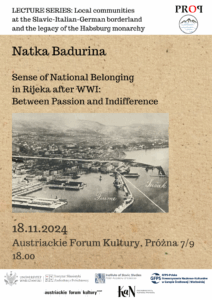 Gabriele D’Annunzio’s occupation of Rijeka (September 1919 – January 1921) confronts the professions dealing with it – historiography, memory studies, literary studies – with the problem of very different, often conflicting and mutually exclusive interpretations.
Traditional narratives about the fall of the Austro-Hungarian Empire usually focus on the rise of national sentiments among its former peoples. The occupation of Rijeka is typically framed as a clash between Italian and Croatian/Yugoslav nationalisms, leading to memory wars, political tensions, and diplomatic incidents that persist to this day. However, recent scholarship seeks to move beyond strictly national categories, revealing habits, attitudes, practices, and emotions that remain deeply tied to the Empire’s legacy. This lecture will explore the benefits and limitations of using “national indifference” to understand the case of post-WWI Rijeka. By drawing on the history of emotions and examples from memoirs, diaries, and literary works, it will expand the discussion of “national sentiment” vs. “national indifference” to include a broader spectrum of emotions – ranging from boredom and indifference to enthusiasm, love, disappointment, anger, hatred, resentment, resignation, and depression.
Natka Badurina is an associate professor in the Department of Foreign Languages and Literatures at the University of Udine, Italy. Her main research interests include the relationship between literature and ideology, gender studies, testimonial discourse, and cultural memory studies in the North Adriatic area. She is the author of the following books (in Croatian): Illegitimate Daughters of Illyria: Croatian Literature and Ideology in the 19th and 20th Centuries (Zagreb, 2009); The Fallacy of the Curse: Sublimity and Gender Roles in 19th-century Croatian Historical Tragedies (Zagreb, 2014); and Fear of Remembering: Literature and the North Adriatic on the Ruins of the Twentieth Century (Zagreb, 2023).
Watch on YouTube: Natka Badurina, Lecture
Rediscovering the Habsburg Legacy in Socialist Yugoslavia and Beyond: the role of Istria, Rijeka and Dalmatia
Rediscovering the Habsburg Legacy in Socialist Yugoslavia and Beyond: the role of Istria, Rijeka and Dalmatia
PL: Odkrywanie dziedzictwa Habsburgów w socjalistycznej Jugosławii i poza nią: rola Istrii, Rijeki i Dalmacji
17.02.2025
Daniel Baric
Sorbonne Université, France
 In the 1980s, a process of rediscovery of the Central European cultural layer in Croatian literature and cultural history began, at first hesitantly. The pioneers of this search for a fresh view on the transnational history of Austria-Hungary were authors and scholars who primarily dealt with urban milieus in the northern Adriatic, in Istria, Rijeka, and to a lesser extent in Dalmatia.
These works were triggered by the search for a cultural and sometimes political alternative in crisis-prone Yugoslavia. Albeit progressively gaining widespread acceptance throughout Croatia, the specific mechanisms of this rediscovery are rooted in local communities in which programs regarding the Austro-Hungarian heritage were developed.
Daniel Baric is Associate Professor in South-Slavic studies at Sorbonne Université. His research deals mainly with history of cultural transfers and entanglements in the (post-)Habsburg context. Latest publications: D. Baric (ed.), Die Lebenserinnerungen von Carl Patsch. Archäologie eines Lebens zwischen Böhmen und Bosnien, Berlin, Frank & Timme, 2023; D. Baric and E. Miloš (eds.), L’Institut français de Zagreb. Fondements et contextes d’une médiation culturelle, Paris, Institut d’études slaves, 2023; D. Baric (ed.), « Les Guerres balkaniques, perspectives culturelles », Balkanologie, vol.17/1, 2022.a
Watch on YouTube: Daniel Baric, Lecture
Postwar transition after 1918 in the Northeast Adriatic: between continuity and discontinuity
Postwar transition after 1918 in the Northeast Adriatic: between continuity and discontinuity
PL: Powojenna transformacja po 1918 r.: między ciągłością a nieciągłością
20.01.2025
Marta Verginella
University of Ljubljana, Slovenia
 After the Italian army’s occupation of the “irredent lands”, both policies of rapid adjustment to the new state structure and attempts to maintain institutional practices of the Empire can be evidenced.
The minority issue i.e., the presence of some 500,000 Slovenes and Croats within the Italian borders will become central to the politics of occupation since the fall of 1918 and also a reason for disagreements between central liberal and regional nationalist positions.
The lecture will analyse government action, the reactions of local society in both its Italian and Slovenian and Pro-Yugoslav voices.
The lecture is not available online.